Webhook vs API: Push, Polling and When to Use Each
Webhook vs API compared on direction, traffic, reliability and cost, with when to use each and how to combine them for async AI media jobs.
The popular advice on webhook vs API is incomplete: use webhooks for real-time updates and APIs for everything else. That skips the hardest part. A webhook receiver is an asynchronous message consumer, and choosing push delivery means accepting responsibility for duplicates, missed notifications, authentication, and recovery. The useful comparison isn't push versus pull. It's traffic economics versus operational control, with a recovery path for whichever channel fails.
Table of Contents
- Webhook vs API at a Glance
- How Each Pattern Moves Data
- Reliability Trade-offs You Must Design For
- When Polling Is the Safer Choice
- How to Build the Hybrid Flow for Media Jobs
- Choose by Workload and Constraint
Webhook vs API at a Glance
| Criterion | API (request-response or polling) | Webhook (push notification) |
|---|---|---|
| Direction | Client sends request, server responds | Provider sends HTTP request to client URL |
| Who initiates | Client | Provider, when an event occurs |
| Timing | When the client asks | When the event occurs |
| Best for | Current state, history, backfills, reconciliation | Notifying apps when state changes or a job finishes |
| Client needs | Outbound HTTP access only | Public HTTPS endpoint, signature verification, storage |
| Delivery | Direct response to each request, if transport succeeds | Normally at-least-once delivery with bounded retries, possible duplicates and reordering |
| Failure recovery | Client retries and checks again | Provider retries; consumer deduplicates and reconciles through the API |
| Cost pattern | Traffic grows with polling frequency | Traffic grows with event volume |
A webhook is an event-delivery mechanism built on HTTP APIs, not a replacement for them. Most production integrations need both: a request path for commands and authoritative reads, plus a notification path for changes.
Say your application submits a video-generation job. With an API, your backend sends a GET request using the saved task identifier and receives the job's current status. Your application chooses when to ask, how long to wait, and what to do if the request fails.
With a webhook, the provider sends a job-complete event to an endpoint you registered. Your backend accepts that notification and schedules the next action, such as retrieving the finished asset. The original browser session doesn't need to remain connected.
Separate the command from the notification
Submitting work and learning that it finished are different operations. An API can accept a task immediately without keeping the connection open until the underlying computation finishes. A webhook then provides a separate completion signal.
That distinction prevents a common design mistake: treating every asynchronous operation as an HTTP request that must remain open. It also prevents the opposite mistake, trying to use event notifications as a complete record of current state.
First decision: Does your application need to react when something changes, or does it only need the answer when someone asks?
If a user opens a job-history screen, fetch the current records. If a completed job should trigger asset delivery while nobody is watching that screen, use an event-driven path. Neither pattern eliminates the need to handle network failures, but each puts the caller in a different position to recover.
How Each Pattern Moves Data
With polling, the client repeats a status request on a timer, whether anything changed or not. With a webhook, the provider initiates a request after an event, so notification traffic follows activity rather than the clock.
The Nylas webhook-versus-polling guide gives the underlying traffic examples: polling one resource every 60 seconds means 1,440 requests per day, while its comparison of 10,000 accounts produces 2.88 million daily polling requests versus approximately 500,000 webhook deliveries.
Traffic and lag by polling interval and event rate
| Scenario | Requests or deliveries per day | Detection lag |
|---|---|---|
| Poll one resource every 60 seconds | 1,440 requests | 30 seconds on average |
| Poll one resource every 5 minutes | 288 requests, calculated from the interval | 2.5 minutes on average |
| 10,000 accounts polling every 5 minutes | 2.88 million requests | 2.5 minutes on average |
| 10,000 accounts receiving about 50 event notifications each | About 500,000 deliveries | Event dispatch time plus any retry delay |
| Text response streamed token by token | One request per generation | Tokens arrive as generated |
The polling averages assume changes occur independently of the polling schedule. They describe the wait until the next check, not the time the provider spends performing the work.
The shorter interval improves discovery time by spending more requests. The longer interval reduces traffic but makes completed work sit undiscovered. At account scale, even a modest schedule creates substantial traffic because every inactive account still gets checked.
Webhook delivery removes that fixed checking schedule, but the delivery count isn't a complete infrastructure bill. API lookups after notifications, delivery retries, receiver storage, and worker execution still consume resources.
These are distinct communication patterns, not interchangeable labels.
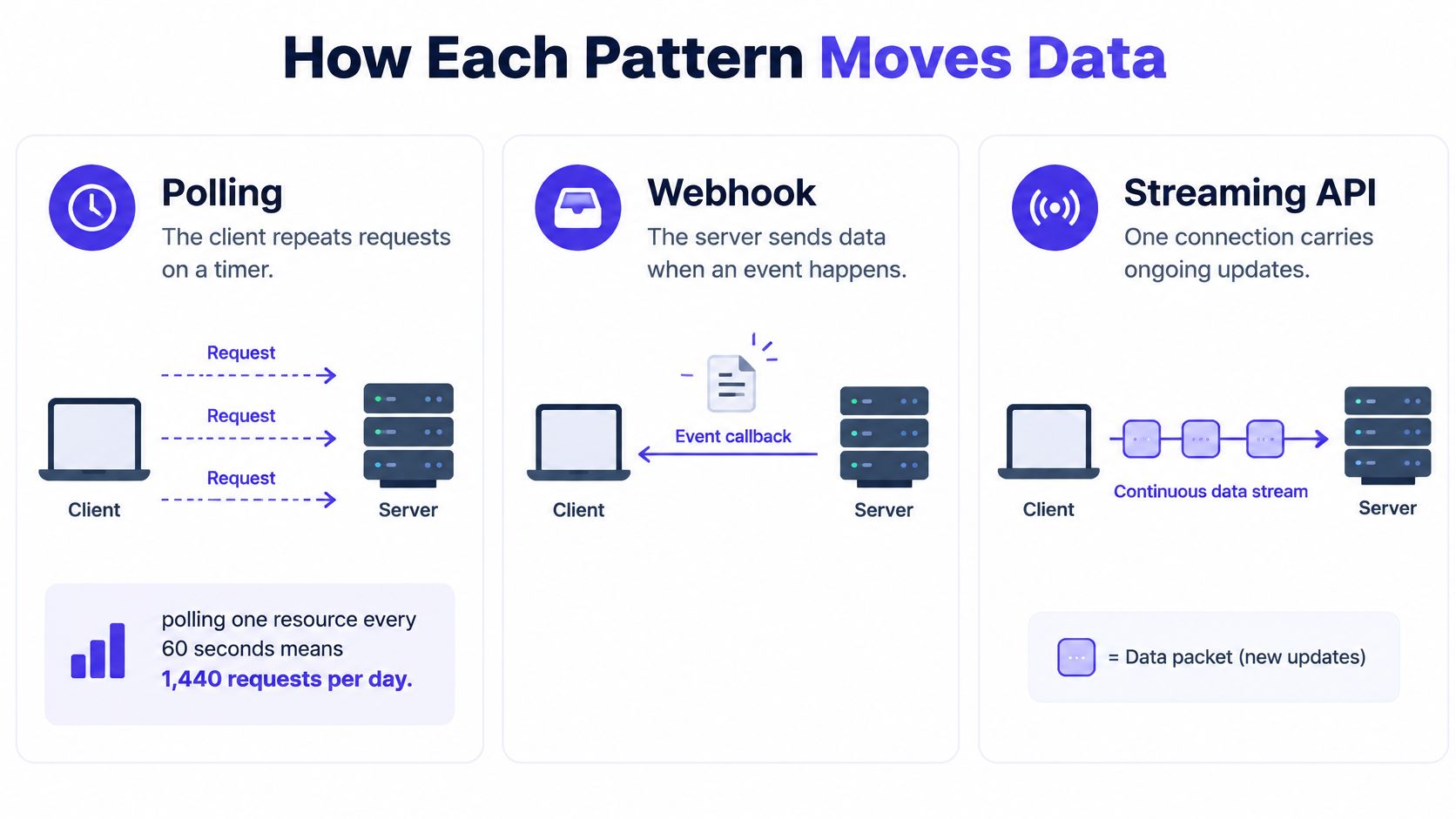
Streaming solves a different problem
A streaming text response keeps the request open and returns tokens as they're generated. For an interactive coding assistant, time to first token and continuity of output matter more than receiving a separate completion callback.
Our text responses stream token by token, while image and video jobs return a task that you poll or receive a webhook notification about when ready. The media API documentation is the starting point for implementing that task-oriented request path.
Estimate your event rate per resource before choosing a polling interval. A quiet resource and a continuously changing resource shouldn't automatically share the same schedule.
For polling, shorter intervals exchange more traffic for less detection delay. Webhooks avoid that particular exchange, but replace it with the cost of operating a dependable receiver.
Reliability Trade-offs You Must Design For
Webhook delivery is normally at least once, not exactly once. That describes the delivery model, not a promise that a provider will retry forever. Bounded retries can still end with an undelivered event, so design the receiver for the worst case rather than the happy path.
A timeout tells the sender nothing about what happened downstream. Your receiver might commit the event to storage, then lose the acknowledgment on the network. When the sender retries, your application receives the same event again and has to absorb it gracefully.
Match each failure to a protection
- Duplicate delivery: Store a stable event identifier under a unique constraint. Where providers distinguish events from delivery attempts, deduplicate business processing by event identity, not by attempt identity.
- Repeated side effects: Make asset publication, account updates, and customer notifications idempotent. Deduplicating ingress does nothing for a worker that crashes after performing an action but before recording success.
- Out-of-order events: Check authoritative state or a documented resource version before applying a transition. A delayed "processing" event must never overwrite a completed task.
- Slow processing: Verify, durably accept, and acknowledge the event before handing expensive work to a queue worker.
Provider retry policies aren't interchangeable. The Supabase webhook documentation requires a 2xx response within 20 seconds, uses exponential backoff, and stops after five failed attempts. The Svix delivery-guarantees guide documents Dynamic's initial attempt plus five retries over approximately one day, alongside Glean's status-specific retry rules.
Documented webhook retry behavior by provider
| Provider | What counts as success | Retry behavior |
|---|---|---|
| Supabase | 2xx response within 20 seconds | Exponential backoff, stops after five failed attempts |
| Dynamic | 2xx response | Initial attempt plus five retries over about one day |
| Glean | 2xx response | Retries connection failures, timeouts, 408, 429 and 5xx; other non-2xx responses are terminal |
Acknowledgment is a durability boundary
Returning success before durable storage creates a loss window: the sender stops retrying, but your application has nothing recoverable. Returning success only after media processing creates the opposite problem: unnecessary timeouts and duplicate deliveries. Acknowledge durable acceptance, not completed business work.
Signature verification belongs before trusting the payload. Preserve the raw request body when the signature scheme requires it, and follow the provider's documented verification procedure rather than signing a reserialized object.
Add dead-letter handling for exhausted worker retries and delivery observability that connects event IDs, task IDs, acknowledgment failures, and processing outcomes. For the polling leg of the same workflow, classify failures with the returned status codes: UberLLM's API refuses calls with error codes such as 402, 404, 429 and 503, which lets a reconciliation job separate a billing refusal from throttling or a temporarily unavailable seller.
A missed poll is recovered by checking again. A missed webhook needs another delivery or an independent reconciliation pass that re-reads authoritative task status on a schedule. Build that pass whether or not you expose a receiver; it is what turns at-least-once delivery into effective exactly-once processing.
When Polling Is the Safer Choice
Webhooks are a delivery reliability problem, not just a faster API. If your application can't support the receiver contract, polling can be the more dependable choice.
The operational difference is easiest to see at the consumer boundary.
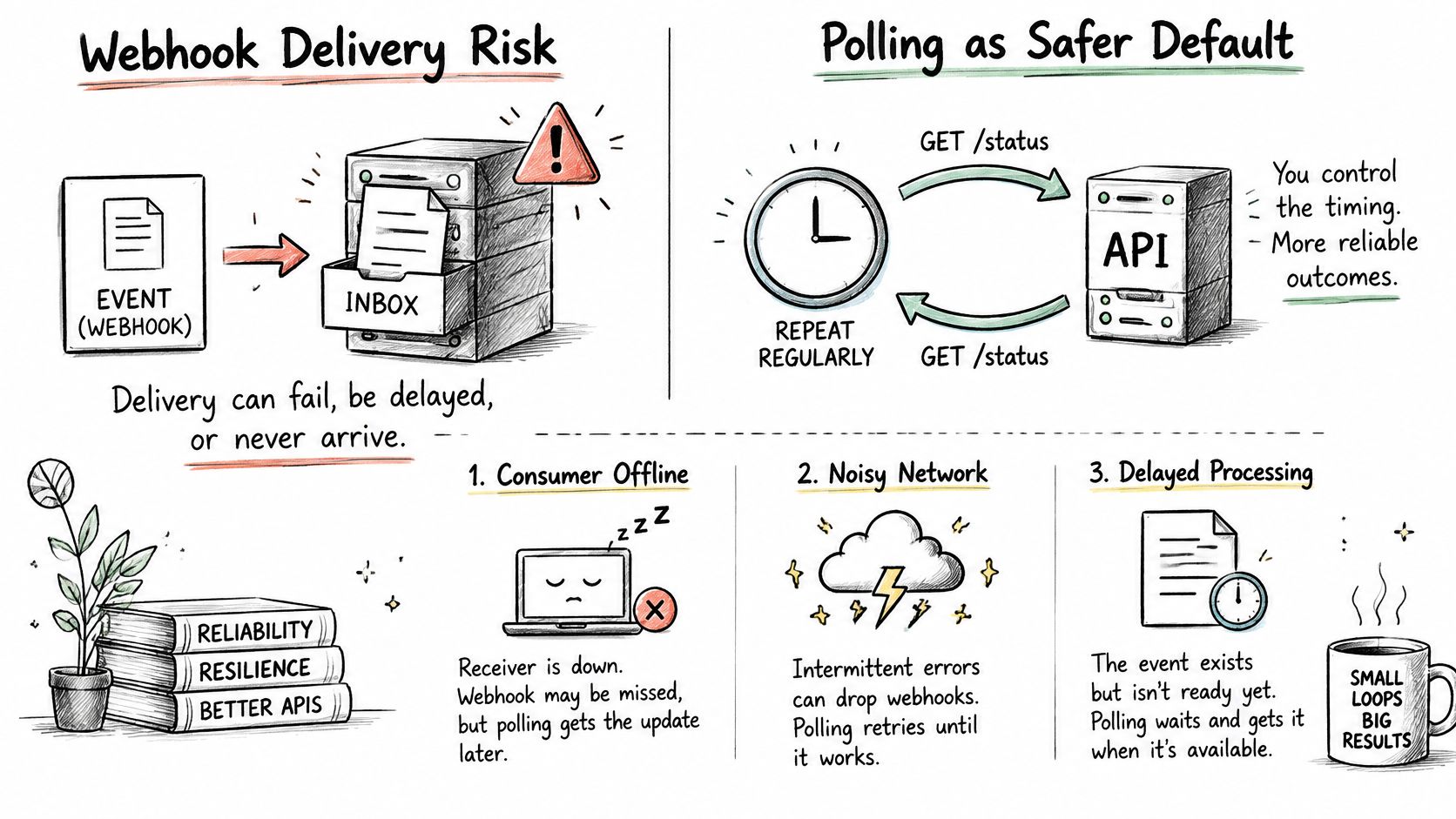
A desktop agent, an internal tool behind a firewall, or an ephemeral CI runner may have outbound access without a stable inbound address. Making those clients receive callbacks can require an additional hosted service, authentication between components, and a durable handoff back to the original caller. That's infrastructure, not a minor configuration change.
Recognize the constraints that favor polling
- No stable public endpoint: Keep communication outbound instead of exposing a temporary development environment.
- No durable event consumer: Poll authoritative status while you build safe storage and processing. A receiver that forgets accepted events isn't an improvement.
- Consumer-controlled recovery: Schedule checks according to your own concurrency limits, maintenance windows, and application deadlines.
Say a build tool on a developer laptop submits a remote media task. It can check periodically until completion, stop when the developer cancels, and resume from the saved task identifier. For a small number of active jobs, that may be simpler and cheaper than maintaining an always-available receiver.
Polling still needs discipline. Back off on transient failures, avoid synchronizing every client's checks, and stop checking terminal tasks. A retry storm is possible with outbound requests too.
The accompanying video offers another way to visualize the request and callback distinction.
Choose the pattern your consumer can recover reliably, not the pattern with the fastest successful demonstration.
Inbound webhook traffic adds endpoint security, signature checks, queueing, duplicate suppression, and availability requirements. Polling gives you explicit control over when the next operation happens, although the provider's rate limits still apply.
Use a webhook with a polling fallback when inbound delivery is practical and frequent events justify it; otherwise, poll with your own cadence, concurrency, and timeout.
How to Build the Hybrid Flow for Media Jobs
A hybrid integration treats callbacks as prompts to check work, not as the only evidence that work exists. Persisted task identity connects the initiating request, incoming notification, recovery checks, and eventual customer result.
We use asynchronous task tracking and webhook callbacks to keep high-volume media workflows moving. For image and video jobs, that tracking means an interruption on one seller doesn't lose the customer's job.
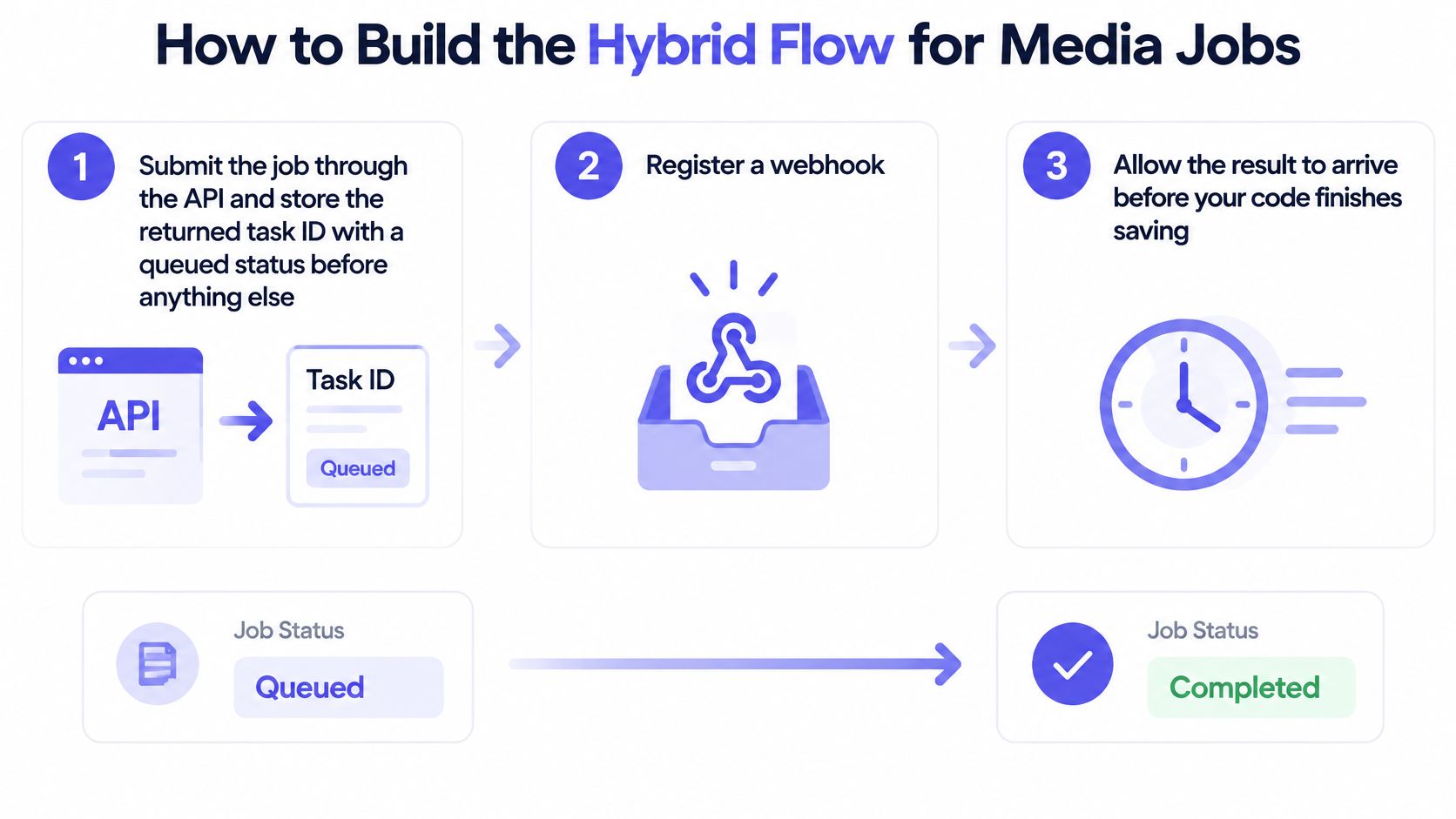
The workflow keeps submission, notification, and status recovery separate.
Establish durable ownership of the task
Submit through the API and save the returned task ID. Persist it with a queued status before starting downstream work. Create a local submission record beforehand where possible, because a fast callback can race the submission response. The common slip is assuming callbacks always arrive after the database commit. Retain unmatched events for later association.
Register a receiver that durably enqueues accepted events. Keep the request handler small and acknowledge promptly after secure acceptance. Don't return success before storage, and don't download or transform the finished asset inside the handler.
Verify authenticity, then deduplicate processing. Signature verification must happen at ingress before an event is trusted or acknowledged; the worker then checks the persisted event identity before applying effects. The common mistake is treating these as optional cleanup after processing. Keep acceptance and processing status separate so an interrupted worker can resume safely.
Converge on authoritative completion
Fetch the task's authoritative status. Use the saved task ID before marking the customer job complete. An event may contain only an identifier, and a delayed notification may describe an older transition. For an image-editing implementation, the photo-editing API guide provides a concrete request workflow to build around.
Poll tasks that remain pending beyond their expected window. Use backoff, jitter, and a maximum attempt count for each checking cycle. Don't blindly resubmit generation when a callback is missing, because the original task may already be complete.
Set an application deadline and reconcile stale tasks daily. Distinguish a failed generation from a status-check failure. If the provider state remains unknown at your deadline, record an explicit recovery or failure outcome rather than leaving the customer interface indefinitely queued.
Health check: Every saved task ID must lead to a terminal application outcome, complete or failed, within your timeout. Keep unresolved provider state visible to operators so an application timeout does not abandon a result that still needs recovery.
Choose by Workload and Constraint
Start with the workload, then reject any pattern your deployment can't support. The fastest notification mechanism won't help if the receiving client can't accept inbound requests or the team can't recover interrupted processing.
Workload to pattern mapping
| Workload | Recommended pattern | Main reason |
|---|---|---|
| Short text generation or coding response | Synchronous API with streaming | One response needed quickly |
| Image, video, music or speech job | Submit via API, webhook on completion, poll fallback | Completion time is unpredictable |
| Mobile or browser client without public endpoint | Polling | Cannot accept provider-initiated inbound calls |
| Backfill or reconciliation of past records | API list calls | Needs current and historical state |
| High-volume event feed such as order status | Webhook with idempotent consumer and reconciliation | Appropriate when event rate is far below the proposed polling rate |
A browser can still receive application updates through its own backend, but that backend owns the webhook receiver. Don't put provider credentials or callback verification secrets into the browser to bypass that responsibility.
The workload and deployment constraint should be evaluated together.
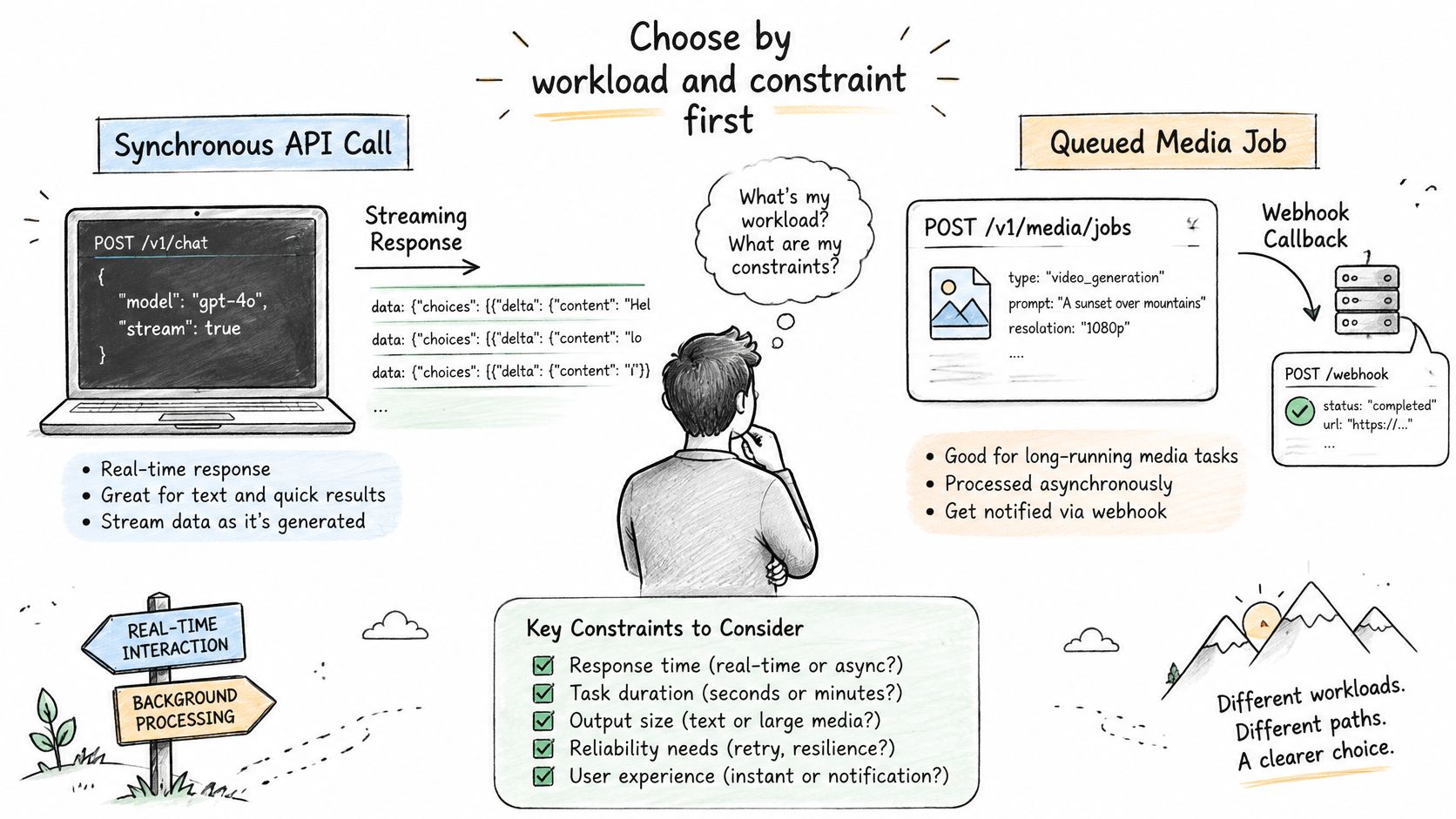
Use total operating cost as the tiebreaker
An analysis cited in Xictron's webhook architecture article found that only 1.5% of 30 million polling requests returned an update. That illustrates how poorly tuned polling can waste traffic, not that every webhook integration will cost less.
Compare polling interval, event frequency, payload size, and provider limits against receiver hosting, queue storage, monitoring, and incident response. Also count the API reads your webhook worker still needs. A lightweight notification followed by an authoritative fetch isn't a request-free architecture.
For a multi-provider application, inspect event-schema consistency and fallback behavior. Normalizing task status into your own application model can matter more than small differences in notification speed.
Selection rule: Prefer the simplest primary path that meets the user-facing requirement, then fund the recovery path before optimizing latency.
Use an API when the application needs an answer to a request. Use webhooks when it must react to changes and can operate a secure, durable receiver. Add independent status checks for long-running jobs, and keep polling consumer-controlled when inbound delivery isn't possible.
Before implementation, write down your expected event rate per resource, whether you can expose a stable endpoint, and how you'll handle duplicate processing. Then make a plain API request and verify that you can save and retrieve the resulting task before adding callbacks.
UberLLM offers all models through one API key and accepts OpenAI and Anthropic wire formats, so existing clients can use the appropriate base URL and credentials. For image and video workflows, choose task polling or webhook notification when the result is ready. Visit UberLLM to test the request path, then add the completion and recovery paths your application needs.