Zangstem Synthese: Hoe het werkt en waar het tekortschiet
Leer hoe zangstem synthese songteksten en noten omzet in gezongen audio, welke trainingsdata en vocoders beheersen, en waar het nog steeds tekortschiet.
Dit artikel is nog niet vertaald en wordt daarom in het Engels getoond.
You've written a melody, fitted the lyrics to it, and loaded a synthetic singer. The first playback is encouraging, until a word rushes past, a held note turns metallic, and the chorus sounds strangely expressionless. Those problems don't necessarily have the same cause. Understanding where each one enters the signal chain makes fixing the vocal much less of a guessing game.
Table of Contents
- What Singing Voice Synthesis Is and Where It Came From
- How a Singing Voice Synthesis System Turns a Score Into Sound
- Why Training Data Decides How Good a Singing Voice Sounds
- Acoustic Models and Vocoders Decide Where Quality Is Won
- How to Judge a Singing Voice Synthesis System
- Practical Uses, Limits and Cultural Gaps
- Confirm Rights Before You Build or Buy a Singing Model
What Singing Voice Synthesis Is and Where It Came From
Singing voice synthesis (SVS) generates sung audio from lyrics, a sequence of notes with pitches and durations, and, in many systems, a selected singer identity. Say you're a songwriter with a finished melody but no singer available. You enter the notes and words to hear how the vocal line fits your arrangement.
This isn't just speech synthesis with a musical backing track. A spoken sentence needs believable phrasing, but a sung sentence must also follow musical pitches, sustain vowels, and place consonants around the beat. A syllable that's acceptable in conversation can sound awkward when stretched across a long note.
From recorded fragments to learned voices
Early approaches used rules and signal processing, followed by systems that assembled recorded vocal units. Statistical and neural approaches subsequently learned relationships between lyrics, musical instructions, and acoustic output, rather than relying only on stitching fragments together.
According to Yamaha's account of VOCALOID's development, the project began in February 2000 through the DAISY collaboration with Universitat Pompeu Fabra in Barcelona, and the first commercial product appeared in 2004. The developers needed a dedicated singing database because ordinary computer input and conventional speech technology couldn't adequately reproduce singing.
Virtual singers such as Hatsune Miku also helped turn synthetic singing into a character-centered creative medium. The voice could become part of an artistic identity, not just a substitute track in a recording session.
Useful distinction: Generating a musical performance and controlling a sung melody note by note aren't the same requirement.
When browsing a music-generation model listing, check the input controls rather than assuming every music tool accepts a vocal score. For a usable singing system, you need to understand its signal chain, recognize its quality limits, and establish how its voices can be evaluated and licensed.
How a Singing Voice Synthesis System Turns a Score Into Sound
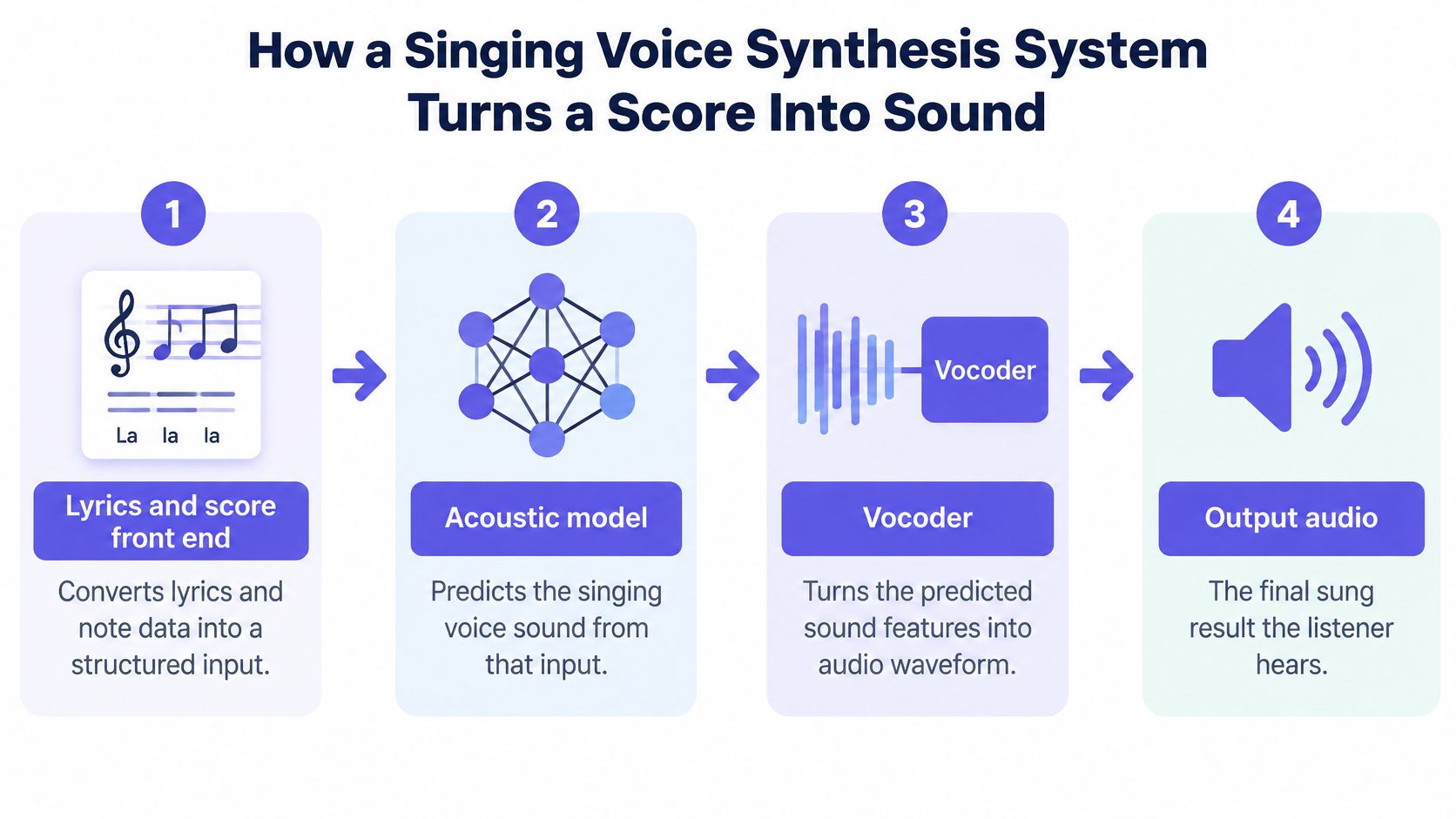
What goes in, and what comes out? In a score-controlled workflow, the input is a musical instruction set. The output is a waveform you can play, edit, and mix.
Pipeline stages in a singing voice synthesis system
| Stage | Input | Output | What It Controls |
|---|---|---|---|
| Lyric and score front end | Lyrics, note pitch and note duration | Phoneme sequence with timing | Which sound is sung on which beat |
| Duration and pitch model | Phonemes and score | Frame-level timing and pitch curve | Vibrato, note attacks and pitch accuracy |
| Acoustic model | Phonemes, timing, pitch and singer identity | Mel-spectrogram | Timbre, vowel shape and articulation |
| Vocoder | Mel-spectrogram | Audio waveform | Clarity, breathiness and audible artifacts |
The illustration shows the broader flow, with duration and pitch decisions incorporated into the prediction process.
Turning words and notes into a performance
The front end breaks lyrics into phonemes, the individual speech sounds within words, and associates them with notes. A written syllable isn't a single uninterrupted sound. In stay, the opening consonants need different treatment from the vowel that carries the sustained pitch.
If the system allocates too much time to the consonants, the vowel can arrive late. If it shortens the vowel to compensate, the word sounds rushed even though the note ends on time. Start with pronunciation and phoneme placement when a lyric feels rhythmically wrong.
The duration and pitch model decides how those sounds unfold through time. The note specifies a target pitch, but the performed pitch curve may include a gentle approach, a stable center, and vibrato toward the end. A perfectly flat curve can sound rigid; an exaggerated transition can sound like an unintended scoop.
Some tools accept explicit note data, while others generate or infer a melody from less constrained inputs, including lyrics. That difference determines whether you can repair a particular note directly or must request another performance.
Turning a performance description into audio
The acoustic model predicts a representation such as a mel-spectrogram, which describes how sound energy is distributed across frequency over time. Think of it as a changing map of the voice's tone, not an audio file you can already hear.
Poorly defined spectral features can produce dull vowels, blurred consonants, or an unstable vocal identity. But dullness alone doesn't prove the acoustic model is responsible. The final waveform generator can also obscure useful detail.
The vocoder converts the predicted representation into sound samples. Buzzing, graininess, or metallic textures may originate here, especially on exposed sustained vowels.
Before editing, identify whether the tool accepts notes and which controls affect the suspected stage. Don't try to fix a misplaced consonant with equalization, or a rough waveform by rewriting a correctly pronounced lyric.
Why Training Data Decides How Good a Singing Voice Sounds
Recording singing is only part of building a useful dataset. Developers also need reliable lyrics, note alignment, phoneme timing, and annotations that distinguish intended expression from mistakes. Without that context, a model may learn an acoustic event without learning when it belongs.
The corpus comparison in the singing-dataset survey illustrates the limited scale and singer coverage of several influential resources, summarized below.
Singing datasets by size and coverage
| Corpus | Singers | Hours | What It Covers |
|---|---|---|---|
| VocalSet | 20 | About 10.1 | Vocal techniques, vowels and varied pitches, not full songs |
| NUS-48E | 12 | About 2.8 | Small corpus with a limited singer pool |
| MIR-1K | 19 | About 2.2 | Small corpus with a limited singer pool |
| CSD | 1 | About 4.9 | 100 songs in two languages from one singer |
| SingNet | Not specified in the cited summary | About 3,000 | In-the-wild singing and sample packs across languages and styles |
The SingNet preprint reports 2,629 hours of in-the-wild singing and 321 hours from sample packs, totaling approximately 3,000 hours. That represents a substantial expansion in available material, but collection size isn't a certificate of musical coverage.
Coverage matters as much as duration
VocalSet's focus on techniques, vowels, and pitches makes it useful for studying vocal behavior. It doesn't make it interchangeable with a corpus of complete, expressively phrased songs. Likewise, a single-singer collection can offer consistency without demonstrating that a system will generalize across vocal identities.
Overfitting means a model becomes too dependent on patterns in its training material. In practical listening, that might mean a convincing familiar vowel but an awkward unfamiliar pronunciation, or a strong result in a represented style and an unconvincing result elsewhere.
For model selection, examine:
- Singer coverage: Look for documented vocal ranges and identities, not just a total recording duration.
- Language coverage: Check whether your lyric language and pronunciation conventions are represented.
- Musical coverage: Distinguish isolated exercises from complete phrases, transitions, and sustained expression.
- Annotation quality: Look for an explanation of how lyrics and notes were aligned with recordings.
The useful question isn't just how much audio a developer collected. It's how closely the documented material matches the performance you need. Missing documentation limits how confidently you can apply a quality claim beyond a polished demonstration.
Acoustic Models and Vocoders Decide Where Quality Is Won
The waveform generator can materially change perceived singing quality even when the upstream predictor stays the same. That makes the vocoder an engineering choice, not just an export step.
In a controlled neural singing synthesis study, CNN-based acoustic models outperformed corresponding feed-forward networks in naturalness tests, and replacing the traditional MLSA vocoder with WaveNet improved both model families. The study trained on 55 Japanese children's songs and 55 J-pop songs, held out five J-pop songs, and used five-point mean opinion scores from 15 listeners evaluating randomly selected test phrases. Those results support a controlled comparison, not a universal ranking across singers, languages, or genres.
Separate prediction errors from rendering errors
An acoustic model can predict the wrong vocal structure. A vocoder can render a reasonable prediction poorly. Both failures may sound artificial, but replacing the same component won't fix both.
For a modular system, test the vocoder using acoustic features extracted from a clean reference recording. This is a resynthesis test: you're checking how well the waveform stage reconstructs information that already exists, rather than asking the acoustic predictor to invent it.
Then synthesize from the score. If reference resynthesis is clear but score-driven output is muddy, investigate the predicted features, alignment, and pitch conditioning. If the reference reconstruction already sounds grainy, address the vocoder or feature compatibility first.
Don't replace the whole model until you've checked whether the defect exists before waveform generation.
This distinction also matters when evaluating adjacent voice tools. A text-to-speech model listing describes a different task; intelligible spoken output alone doesn't establish sustained-note quality or score control.
Choose fidelity and latency for the actual job
WaveNet-like autoregressive vocoders generate audio sequentially, which can increase latency. Faster alternatives, including LPCNet, may be more appropriate when responsive playback matters.
For offline rendering, you may accept a longer wait to preserve vocal detail. For interactive composition, you may prefer a quick preview and reserve a higher-quality render for review.
Measure both generation time and the artifacts you can hear under your intended workflow. A beautiful isolated render is less useful if it interrupts every small melody edit, while a responsive preview shouldn't be mistaken for the best final output the system can produce.
How to Judge a Singing Voice Synthesis System
A voice can sound natural while drifting off pitch, or follow the notes accurately while sounding thin. No single quality score describes the whole performance. You need listener judgments alongside measurements of the generated signal.
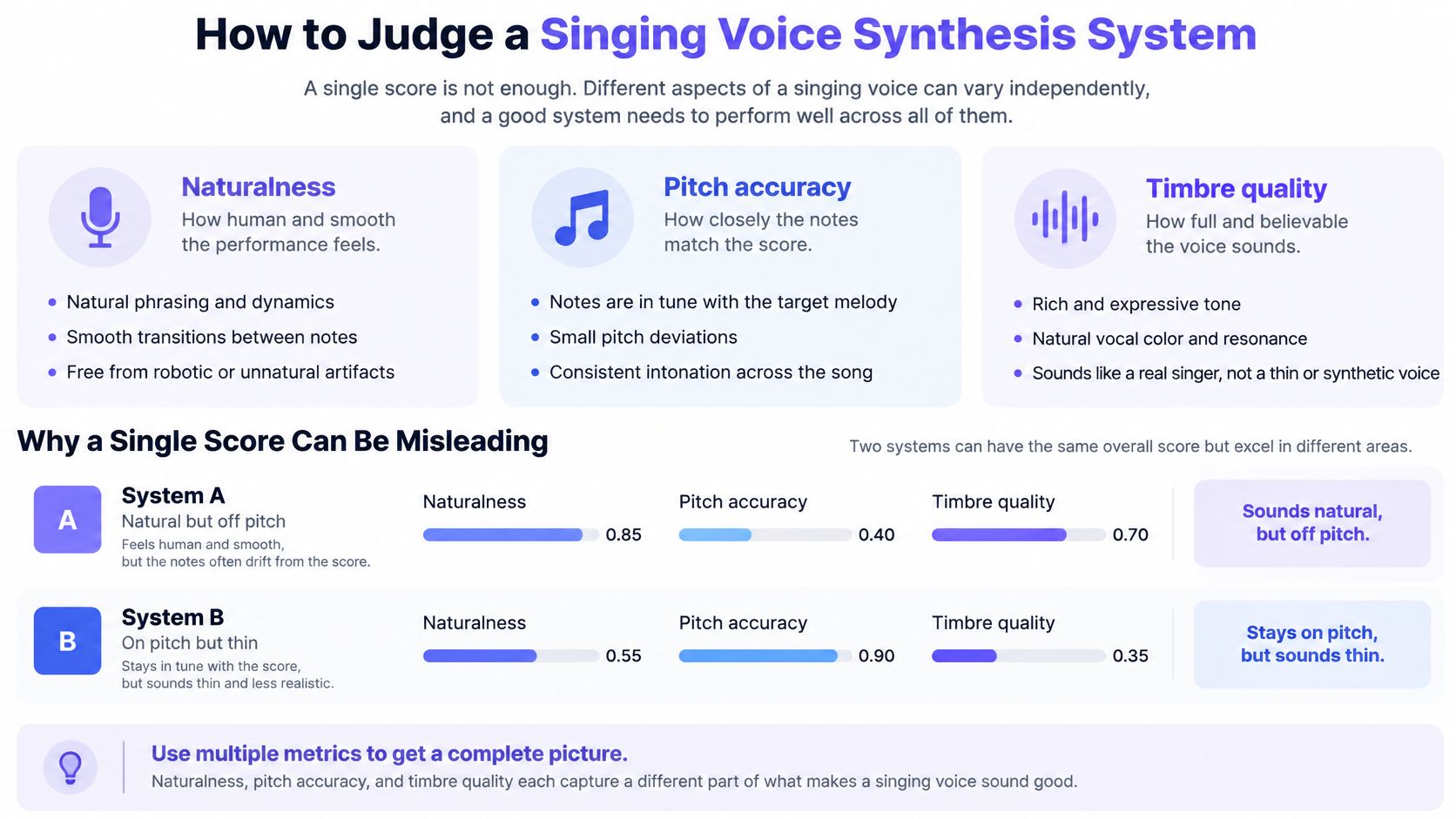
The WeSinger 2 paper uses MOS, F0 root-mean-square error, and mel-spectrogram distortion to examine complementary aspects of singing quality. Its multi-singer conditional adversarial training improves MOS over the earlier WeSinger system on Opencpop and Data-L, but comparative gains differ across the datasets, underscoring the importance of singer and corpus conditions.
Metrics for judging singing voice synthesis quality
| Metric | What It Catches | What It Misses |
|---|---|---|
| MOS | Overall perceived quality from listeners | Can conceal pitch drift and singer-specific detail |
| F0 RMSE | Pitch, intonation and tuning error | Breathiness, pronunciation and timbre |
| MSD | Spectral mismatch linked to timbre and articulation | Whether a phrase feels expressive or on-style |
Read the measurements together
MOS, or mean opinion score, summarizes listener ratings. It's useful for asking whether people prefer the overall result, but interpretation depends on what they heard and what they were asked to judge.
F0 RMSE measures error in fundamental frequency, the acoustic quantity associated with perceived pitch. It helps reveal tuning problems, but it doesn't establish that the words are intelligible or the vocal tone is believable.
MSD compares spectral representations. It can expose differences related to articulation and timbre, but matching a reference spectrogram isn't the same as making a convincing artistic choice.
Listening check: Audition the vocal alone before judging it inside a dense mix. Accompaniment can make weak consonants and unstable note endings harder to notice.
Build an evaluation set containing unfamiliar songs and, where the system supports them, held-out singers. Include sustained vowels, consonant-heavy lyrics, register changes, and phrases that require deliberate expressive timing.
Report the metrics together, then listen specifically for breathiness, pronunciation, and vocal identity. If a vendor offers only a headline naturalness score, treat it as evidence about that listening test, not proof that your lyric, singer, and arrangement will work equally well.
Practical Uses, Limits and Cultural Gaps
A songwriter can use synthetic singing to check whether a chorus is singable before arranging a session. A producer can audition a harmony, while a game team can test how a character's song fits a scene. These are practical uses because the generated performance helps people make a concrete production decision.
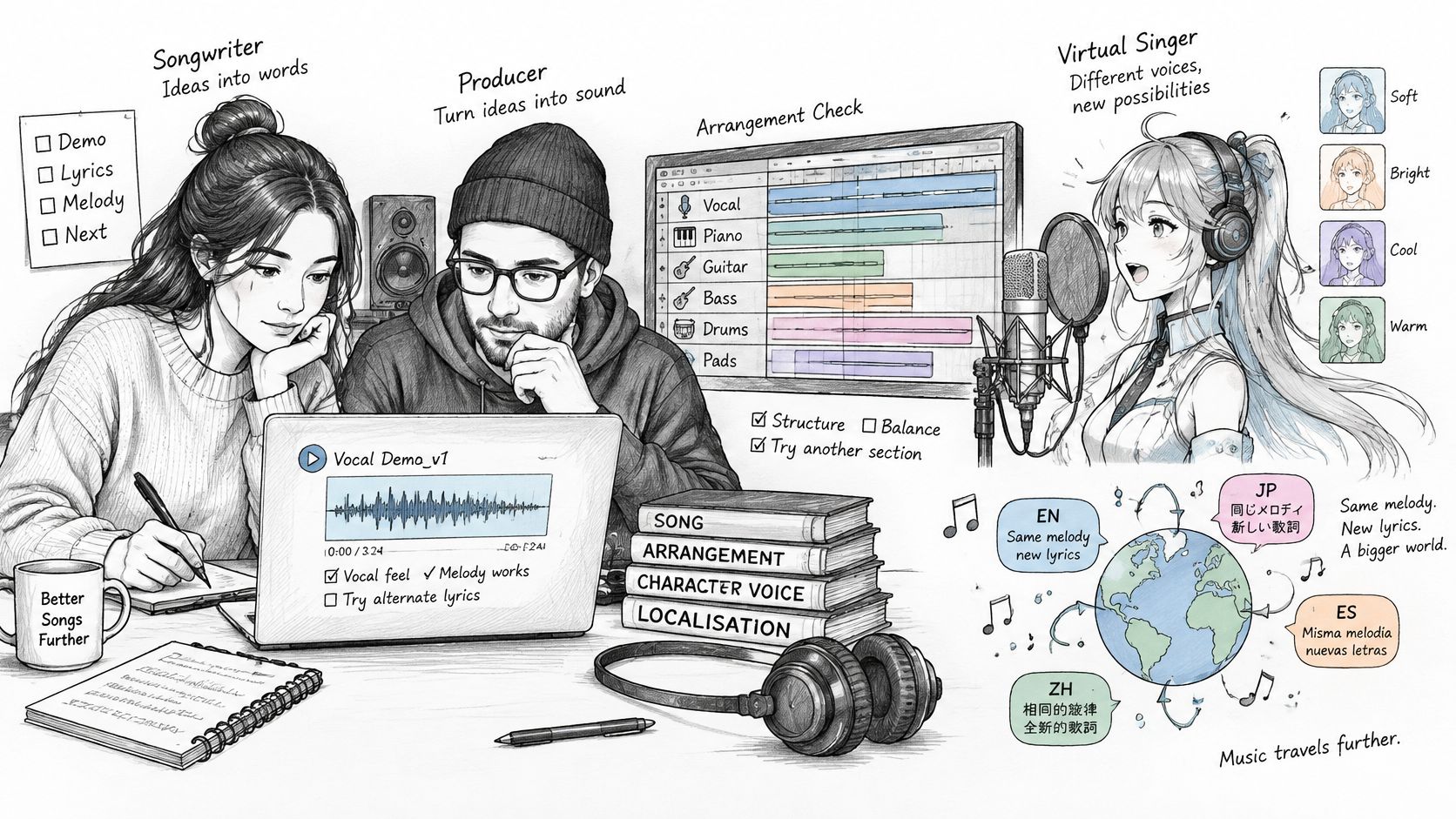
Character-centered releases and animation prototypes can also use a deliberately synthetic vocal aesthetic. For audiovisual prototyping, a guide to making an AI music video can help connect the audio workflow to visual production, but the vocal still needs its own musical review.
Test expression, not just correct notes
Localization is a useful example of where an apparently simple task becomes demanding. Keeping the melody while changing languages means fitting new syllables, stress patterns, and consonants into an existing phrase. A literal translation may be unsuitable as a sung lyric.
Culturally specific expression adds another layer. The chapter on Indian classical singing describes ornamentation in relation to the particular note, raga, singer, and musical context, details that conventional pitch and intelligibility measurements may miss.
Use targeted tests rather than asking only whether the result sounds human:
- Ornamentation: Have a musician familiar with the tradition judge the movement between and around notes.
- Code-switching: Place a language change inside a phrase and check accent, stress, and continuity of vocal identity.
- Rare words: Test names and unfamiliar lyric vocabulary, then have a fluent speaker assess pronunciation.
- Phrasing: Compare where the generated singer breathes, emphasizes a word, or releases a sustained ending.
Verify origin separately from quality
A convincing vocal doesn't establish who performed it. The National Institute of Justice's account of the inaugural Singing Voice Deepfake Detection Challenge reports 47 participating teams and a top-team equal-error rate of 1.65% in the challenge setting.
That result demonstrates measured detector performance under particular conditions, not guaranteed authentication of an arbitrary release. Treat detection as one check alongside provenance records, source files, and documented authorization.
Synthetic singing is particularly useful for drafts, prototypes, and intentional character voices. A final commercial vocal, especially on a major release, needs human review for musical expression, language accuracy, identity, and provenance rather than approval based on a clean-sounding demo alone.
Confirm Rights Before You Build or Buy a Singing Model
Who has authorized the voice before it's trained, cloned, or released? A vocal recording can involve a performer, a recording owner, a lyricist, and a composer. Permission concerning one contribution doesn't automatically settle the others.
The AI & Society article on singing-data governance warns that a standard Creative Commons license may not adequately protect singing-data contributors, because recordings can contain both a performer's voice and a copyright-protected song. It also distinguishes U.S. fair-use rules from the EU text-and-data-mining exception rather than treating them as interchangeable permissions.
Put the permitted uses in writing
Use a rights checklist before transferring recordings or integrating a model:
- Identify the relevant rights. Document permissions concerning the singer's recordings, lyrics, composition, likeness, and intended commercial release. Record who can authorize each use rather than assuming the person supplying the file controls everything.
- Specify the model activities. State whether the agreement permits training, fine-tuning, voice cloning, redistribution, and downstream commercial use. A license to publish an audio track shouldn't become permission to build a reusable voice model.
- Read the license terms. Don't rely on a Creative Commons label alone. Check whether the terms address the performer's contribution and the underlying song.
- Check the applicable jurisdiction. Have qualified counsel assess the rules relevant to the recordings, contributors, and deployment. Don't transplant an exception from another legal system into your agreement.
- Plan what happens after training. Define revocation procedures, model removal, attribution, and revenue sharing. Specify who handles requests and what remedies are technically and contractually available.
Keep evidence with the production assets
Maintain a permissions record alongside the dataset or project. Include the agreement version, permitted uses, source recording identifiers, and any restrictions on distribution. That makes it easier to distinguish an authorized input from a file that merely arrived in a shared folder.
Public availability isn't proof of consent or ownership. Nor should a promise to remove a recording be confused with a demonstrated ability to remove its influence from an already trained model.
Before building or buying a singing model, get written terms covering each relevant right, permitted activity, and post-training obligation.
UberLLM is an API for text, image, video, music and speech models. If you're building a singing-related production workflow, visit UberLLM to explore model listings and compare their documented inputs with your requirements for score control, audio output, and surrounding media tasks.